
What is the missing link to neck and back pain treatment in Toronto? Well, if you’ve ever dealt with neck pain, back pain, or recurring stiffness, you’ve probably asked yourself some version of this question:
** “Why does this keep happening?” **
Maybe the pain comes and goes.
Maybe it improves, then returns.
Or maybe it showed up seemingly out of nowhere.
What most people don’t realize is that pain is often just the **end result of a process** that’s been building for weeks, months, or even years.
To really understand what’s going on—and more importantly, what to do about it—you need to understand one key concept:
**Pain and dysfunction are not the same thing.**
And once you understand how they’re connected, everything about recovery, prevention, and long-term health starts to make more sense, as does getting started with neck and back pain treatment in Toronto.
—
**Step 1: What Is Dysfunction?**
Before pain begins, your body almost always goes through a phase called **dysfunction**.
Dysfunction simply means:
**Your body is not moving or working as well as it should.**
This can include:
* Joint restriction (things not moving freely)
* Muscle imbalances (some muscles overworking, others underworking)
* Postural strain (from sitting, screens, repetitive tasks)
* Reduced circulation or stress on tissues
At this stage, you might not feel pain.
But your body is already compensating.
And compensation is where problems begin.
—
**Step 2: What Happens If Dysfunction Is Left Alone?**
If dysfunction isn’t addressed, it can lead to two different outcomes:
**1. Symptoms**
This is what most people notice:
* Pain
* Stiffness
* Tightness
* Reduced mobility
* Altered sensation
**2. Degeneration**
Over time, stress on the body can lead to structural changes such as:
* Arthritis
* Disc changes or bulges
* Tendon irritation
Here’s where things get interesting—and often misunderstood with neck and back pain treatment Toronto.
—
**Step 3: The Big Misconception About Pain and Structure**
Most people assume:
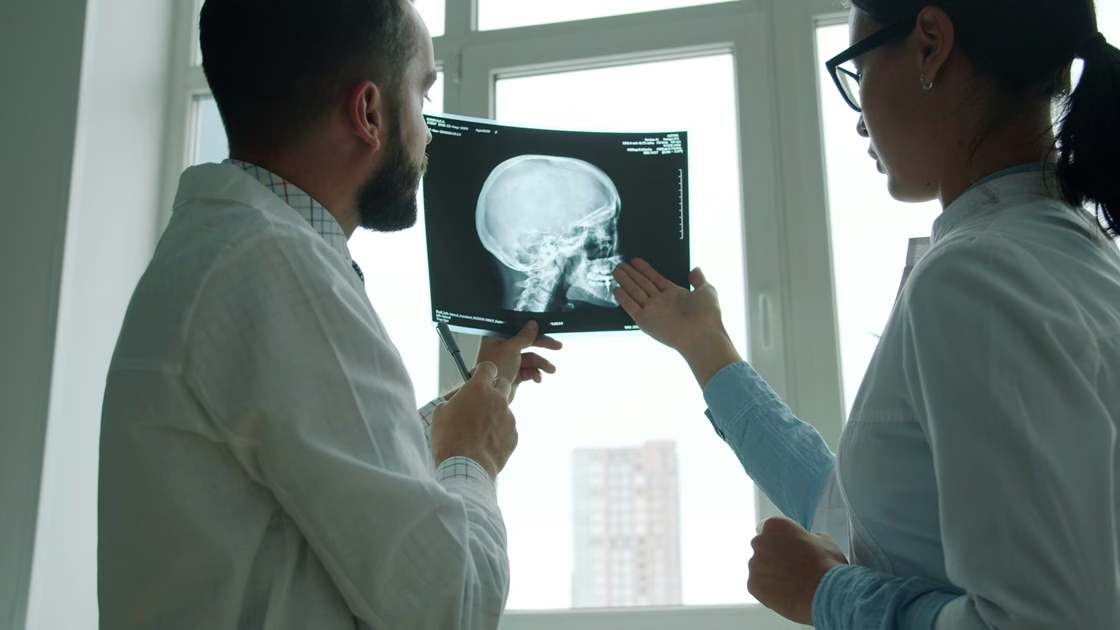
> “If something looks bad on an X-ray or MRI, that must be the cause of the pain.”
But research tells a very different story.
According to large studies:
* Many people with disc bulges have **no pain at all**
* Arthritis is extremely common—even in people who feel fine
* Structural “abnormalities” increase with age, whether pain is present or not
In fact, degeneration is often **asymptomatic**.
That means:
👉 You can have structural changes and feel perfectly fine
👉 You can have pain with very little structural change
So what’s the missing link?
—
**Step 4: Function Is What Really Matters**
The difference between someone who feels good and someone who doesn’t is often **how well their body functions**.
When your body:
* Moves well
* Distributes stress evenly
* Adapts to physical demands
…it tends to stay healthier and more resilient.
But when function breaks down:
* Certain joints take more load than they should
* Muscles compensate and fatigue
* Movement patterns become inefficient
That’s when symptoms start to appear.
And over time, that same dysfunction can contribute to structural wear.
—

**Step 5: Why Pain Isn’t the Best Guide**
Pain is important—but it’s not always a reliable indicator of what’s going on.
Here’s why:
* Pain often shows up **late** in the process
* It doesn’t always match the severity of the issue
* It can go away even if the underlying problem remains
That’s why simply “waiting until it hurts” can keep you stuck in a cycle of recurring problems. It’s always best to seek out neck and back pain treatment Toronto in a timely fashion to nip things in the bud.
—
**Step 6: What Actually Solves the Problem?**
If dysfunction is the root cause, then the solution becomes much clearer:
**You need to restore function.**
That doesn’t mean chasing perfect posture or doing complicated routines.
It means improving how your body:
* Moves
* Coordinates
* Handles stress
This is where conservative care—like chiropractic treatment—can play an important role.
—
**Step 7: Where Chiropractic Care Fits In**
Chiropractic care focuses on improving function, particularly in the spine and joints.
Through targeted adjustments and movement-based care, it can help:
* Restore joint motion
* Reduce mechanical stress
* Improve communication within the nervous system
* Support better movement patterns
And importantly, it does this without drugs or surgery.
Research also shows that many common conditions respond well to conservative care:
* The majority of disc herniation cases improve without surgery
* Spinal manipulation can be effective for certain disc-related conditions
* Many shoulder issues respond just as well to non-surgical care
This is why a conservative approach is often the best place to start.
—
**Step 8: Relief vs. Recovery vs. Prevention**
To make this practical, it helps to think in three phases:
**1. Relief**
* Reduce pain and irritation
* Improve basic movement
* Start calming things down
**2. Recovery**
* Restore proper function
* Improve strength and coordination
* Reduce the chance of recurrence
**3. Prevention**
* Maintain good movement
* Catch small issues early
* Stay ahead of future problems
Most people focus only on relief.
But lasting results come from moving through all three.
—

**Step 9: What You Can Do Right Now**
Even without treatment, there are simple ways to support better function:
**1. Move More, Sit Less**
Avoid staying in one position too long.
Even small breaks help reset your system.
**2. Build Strength and Mobility**
You don’t need complicated programs—just consistency.
**3. Pay Attention to Early Signs**
Stiffness, tightness, or imbalance are often early warnings.
**4. Don’t Wait Too Long**
Addressing issues early is almost always easier than fixing them later.
—
**Step 10: A Better Way to Think About Your Body**
Instead of asking:
❌ “Why does this hurt?”
Start asking:
✅ “How well is my body functioning?”
That shift alone changes how you approach your health.
—
**Final Thoughts**
Pain can be frustrating—but it’s also useful.
It’s your body’s way of telling you something isn’t working as well as it should.
If you focus only on the pain, you might get temporary relief.
But if you focus on improving function, you give yourself the best chance at:
* Long-term relief
* Better movement
* Fewer recurring problems
* Greater confidence in your body
And whether you’re currently dealing with pain, feeling a bit off, or simply want to stay ahead of problems…
That approach works at every stage.
—
**If You’d Like Help**
If you’re dealing with neck pain, back pain, or movement issues—or just want to stay proactive about your health—we’re here to help.
At the Toronto Neck and Back Pain Clinic, we focus on simple, practical, evidence-informed care designed to:
* Help you feel better
* Help you move better
* Help you stay better
No pressure. No long-term commitments.
Just the right care, at the right time, based on what you need.
(If you’re looking for neck and back pain treatment in Toronto, our clinic is conveniently located in Midtown Toronto near Yonge and Davisville, offering simple, effective chiropractic care focused on restoring function and helping you feel better—without unnecessary long-term plans.)